Wednesday, May 19, 2010

A GRADUAL JOURNEY TO THE OIL SPILL


Wall, New Orleans


WALKING

The West of which I speak is but another name for the Wild; and what I have been preparing to say is, that in Wildness is the preservation of the world. H.D. Thoreau from the essay, Walking.
"It was a pleasure and a privilege to walk with him. He knew the country like a fox or a bird, and passed through it as freely by paths of his own." - Ralph Waldo Emerson on his friend Henry David Thoreau.
Walking is like writing in that each is a narrative, a collection of images one notices or is sometimes impaled upon. Walking, say, from one end of the airline terminal to the other entails countless decisions, small and barely conscious left and right turns, people we look at or choose not to, the way a thought influences the hunch of our shoulder or whether we are able to smile when asked for our photo I.D. The narrative of that walk is a never to be repeated and soon to be forgotten memory of it, though not memory as something vanished we might later recall, but the lingering, intangible atmosphere of it, how it felt to us and - a question we seldom ask! - how we felt to it.

Space and its atmosphere, its living flavor that we co-create with it, is what we walk though. Writing is the reconstruction of images and atmosphere, a selective process, a subjective chaos given an identity the writer discovers through writing. Thus walking and writing are practice

 Near Paris Ave. and Robert E. Lee,
New Orleans.

Friday, 14-May: After I fetched my suitcase from baggage claim, I exited Chicago's Midway International airport through a corridor that took me past a series of photographs taken by telescopes, some earthbound others in  orbit, such as the Hubbel. The photos were all compelling but none more so than the picture of our earth, with the Gulf of Mexico vividly in view and free of clouds. I was going there, to "witness the oil spill" to be in a place where the consciousness of many of us has become impaled, the oil spill a blunt reality and symbolic spear penetrating many issues and conflicts.
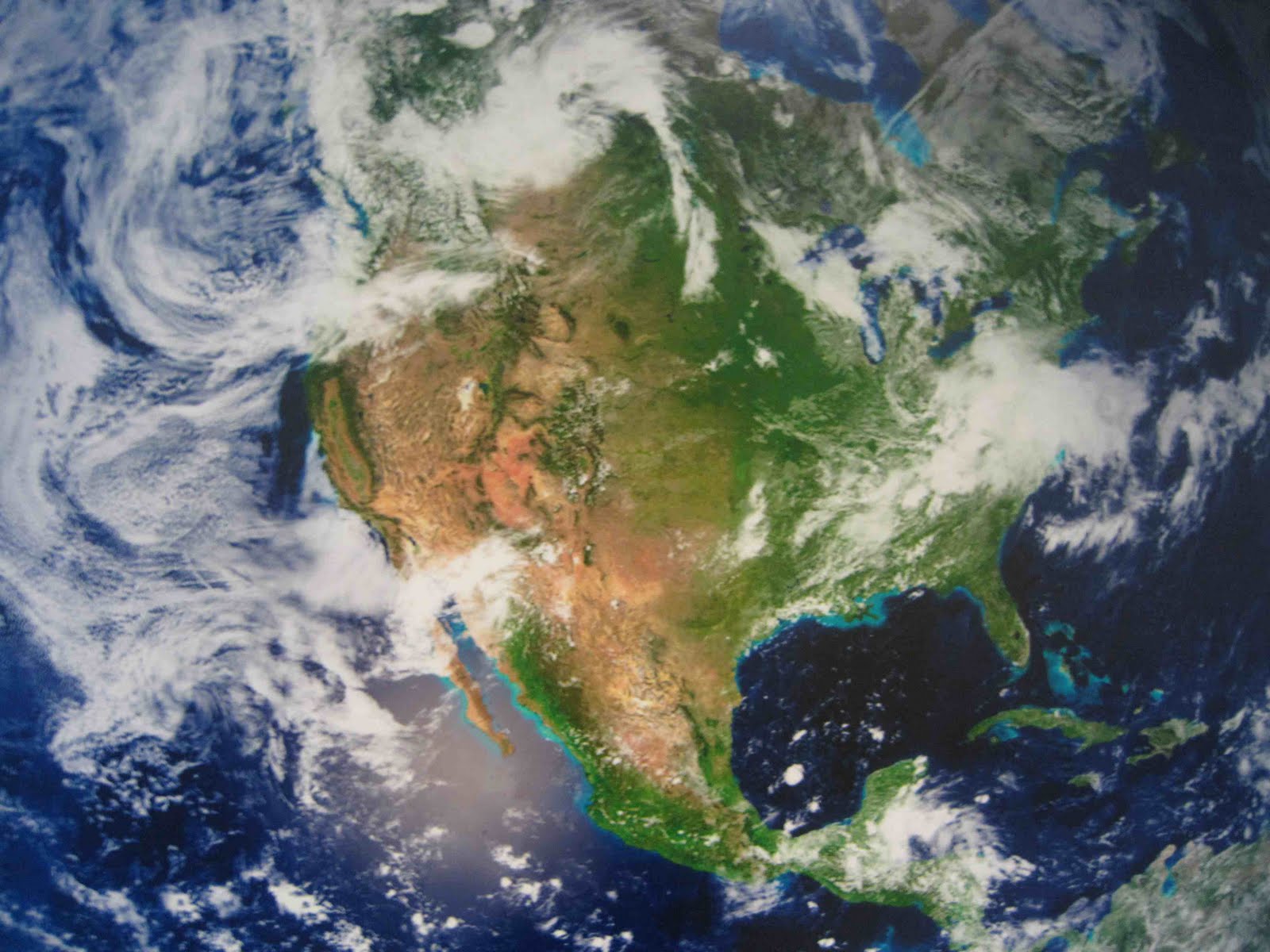
North America.

Even though I am traveling by bus, airplane, taxi and subway, I am still walking to New Orleans. That is the way I am experiencing it, that is the narrative I am choosing to live and write about: various parts commitment, compromise, hypocrisy and paradox. I am committed to writing and filming about issues of environmental sanity, social justice and the "awake" potential of each individual. Yet every plastic bag I use and throw away, destined for land-fill or the world's oceans, is an act of environmental insanity. Even heating my home is a profligate use of the world's finite natural gas reserves and a contribution to global warming. Nearly every activity a so-called middle-class person engages in is positioned somewhere between compromise and hypocrisy (perhaps the very definition of karma?).


Statues in front of house,
New Orleans.

To underscore this equation, I received an e-mail from a reader of my Journal who is also a friend. Her opinion of me is also my opinion of myself, certainly from one corner of the paradox.
There is one thing that stopped me in my tracks this morning and that is, after many references to flying here and there all over the world to write about it, that you are going to fly to New Orleans to witness the oil spill. This is something I cannot understand about almost everyone around me. WHY ARE YOU FLYING? WHY ARE YOU DRIVING? If you care so much about oil spills, why are you using so much oil flying here and there? This is something I've come up against in the ecological world and bird-watching world. The very ones proclaiming how much they care about something are the very ones destroying it. Forgive my rant -- I have become allergic to hypocrisy.
The e-mail offers a chance to establish a "madhyamika" (the Buddhist method of examination the reveals phenomena to be empty of "self-nature" by exposing  the extremes of eternalism and nihilism to be equally invalid) for our actions and deeply held unconscious beliefs. The following incomplete list is merely a starting point for this argument.
1. In our use of precious resources (gasoline, water, paper) do we consider how they have come to us and for what purpose (creative, kind, mindless, useless) we using them?
2. Do we feel entitled to our wealth? That we somehow have the right to it, an attitude which might be a "primitive belief" (Gampopa), a very dull appreciation of Indra's net.

3. Have we examined our "first-word privilege," that if we own a passport and have  the money to travel, for instance, we are infinitely more privileged that most of our neighbors on this planet. There is tremendous potential and power for good or indifference in the exercise of our privilege. 

4. Setting-sun, as Chögyam Trunga defined it, is a life and lifestyle oriented to seeking pleasure, comfort and convenience. Great Eastern Sun, on the other hand, is a life that "attracts the dralas" by staring into nowness, seeing the simple yet unfathomable demand that the moment makes upon us, a coil of fearless, loving and intelligent awake
 Girl on Metra, Chicago.


 Shoes on Metra, Chicago.


IMMIGRATION and CURRENTS

Immigration is "the introduction of new people into a habitat or population" and is therefore another word for walking. My three-day Chicago walkabout led me from Midway to a hotel on the Chicago River to a wedding, a visit to the Art Institute

I went out looking for breakfast later in the morning and turned right rather than left on Armitage Avenue. One block later the neighborhood became a primarily Mexican one, of recent immigrants, "legal" and "illegal," from south of the U.S. border. I entered a grocery of astonishingly low prices and few signs in English. When I've traveled in Mexico I've felt embraced by the warmth of the Mexican people but in the grocery I encountered the same  body-language I often do back in Boulder among my Mexican neighbors. A hesitation to make eye contact, a slightly noticeable hunch of the shoulders, a closing in, a making oneself slightly shorter, less visible, a movement to avoid radar that is also a shield. I am perceived as an agent of the less welcome side of America, its law, politics and still primarily white power base, and in detecting this my own body tightens into a stiff nonchalance (as if such a thing were possible). Once inside, say, a restaurant and engaged in conversation, our smiles come out, but there is naturally or potentially still a distance.


Shop, Chicago


Worker, Chicago.

Like viewing a body of water, seeing the surface but not the depths which tell us so much more about it, humanity is also fluid, with untold, unseen currents that hold truths headlines obscure. The North American Free Trade Agreement was signed in 1993. Headlines promised improvements for the American economy and a massive lifting out of poverty for Mexicans. But the agreement overrode local and national environmental laws and opened the way for U.S. agribusiness to flood the Mexican economy with cheap corn, which rapidly wiped out the livelihood of 2.5 million farmers and only fueled a desperate need to migrate el norte. During the booming economy Mexicans were essential to our labor force (still are). Just as our body has a skin to repel the other, countries create borders to keep the other out and/or keep us in (borders that are also fluid; before 1848, Mexico ended just south of Casper, Wyoming) and immigration laws are obviously necessary. But the future promises rising ocean waters  that may force millions from coastal cities, as well as food crisis and water shortages. The kind of migrations we will see in the future are inconceivable. What kind of walls will we have? What kind of neighbor will each country be? Who will be the other?"

Store window, Chicago.

This advertisement for money transfer services in a store window on Amritage Avenue, signifies a kind of caring I can only admire. It is not in the fees, often steep, a company like Sigue charges to wire transfer funds, but in the $13 billion (a 2003 figure) sent annually by migrant workers in the U.S. back to their families in Mexico. The beautiful, selfless goodness of it. And probably the only way many survive the emotional hardship of being alone and undocumented in a foreign country, for who would chose such a life willingly unless driven by economic necessity?


NEW ORLEANS

After three days of being in New Orleans, I am finally writing about it. I have passed through the membrane of arriving as pure neophyte, a man who'd never set foot in the Deep South, and now know the look of Bourbon Street and Lake Pontchartrain. Names that entered me in the years since Katrina have now become tangible, such as the Ninth Ward, which I walked through yesterday in blazing heat to discover odd juxtapositions of the derelict and gentrified. Some houses boarded and rotting from the inside out, others seamlessly puttied and coated in glowing Sherman Williams latex paint. I stopped to film two young people on the porch of their house, white, tattooed, with a flask in a brown bag they were sharing; the young woman from California with the look a a runaway and the young man a native with a dog named Grimace. The man had grown up in New Orleans and agreed with me that everything here was beautiful, from this semi-wasted Ward to all the other concentric rings of the city.

 Wall, New Orleans.

I stopped at another porch, five young black women (though one was a grandmother) and a couple of under four-year-olds. The accepted me with the same good-humored tolerance that people in Cambodia would; some fool with a camera and an indeterminate purpose. I began the interview and, like a fool, later realized I hadn't pressed the video record button. I lost a thirty second statement by an eighteen year-old named Jasmine who, when I asked how it has been since Katrina, replied with a heart-breaking simple, gentle, plaintive candor, "It's been real hard and it's still real sad so many are gone." I asked her about the "so many" and in her case both her cat and grandmother were drowned in the flooding. Plus the rents are going up and the water around and under them seems poisoned.

Corner building, Ninth Ward, New Orleans.

In the membrane between neophyte and experience ("neophyte" also means an adult convert to Christianity; I have converted to falling in love with New Orleans) I am often in bewilderment, often hot and lonely, penetrated by an emerging but still confused sense of why I came here and for what purpose. I could have learned as much or more about the oil spill simply by staying at home and researching the Internet. In general, people here know only a little bit more than the rest of us, it is still abstract, tangible only through newspapers and television. The oil spill is moving closer and has now made contact with the shores of Louisiana. Fishermen are already effected, restaurant workers know they soon will be. I sense that whatever I "learn" or "experience" will be secondary to a feeling that is already upon me, that I have moved closer into the global calamity.

Cross, Ninth Ward, New Orleans.

I am seeking to understand the oil spill in terms of the drala principle, which is a three-fold understanding, one that cannot found in a single newspaper or a single web-site. The three-fold drala principle is taking responsibility for our state of mind, state of body, state of the world. Responsibility for our state of mind means our attitude, our "secret" intention (one that cannot be seen by others, only felt) such as how we hold others in our heart (heart and mind being the same). Responsibility for our body means how we treat, dress and experience it. It is not a set of puritanical guidelines (though rules can play a part) but one of extending awareness to our body so that body and mind "talk" to each other,  are joined. For example, a smile joins body and mind (as well as self and other). Responsibility for the world means we become aware of our effect upon it, that we take responsibility for decreasing harmful effects and increasing beneficial ones. Responsibility brings joy, love, and hardship, it is like raising a child.

Prayer Flags, French Quarter, New Orleans

We can only make this three-fold commitment by realizing that body, mind and world are all equally "alive" and are one. This is a "spiritual" solution to the issues of war and environmental destruction. This is a spiritual approach to survival.


Lake Pontchartrain, New Orleans.
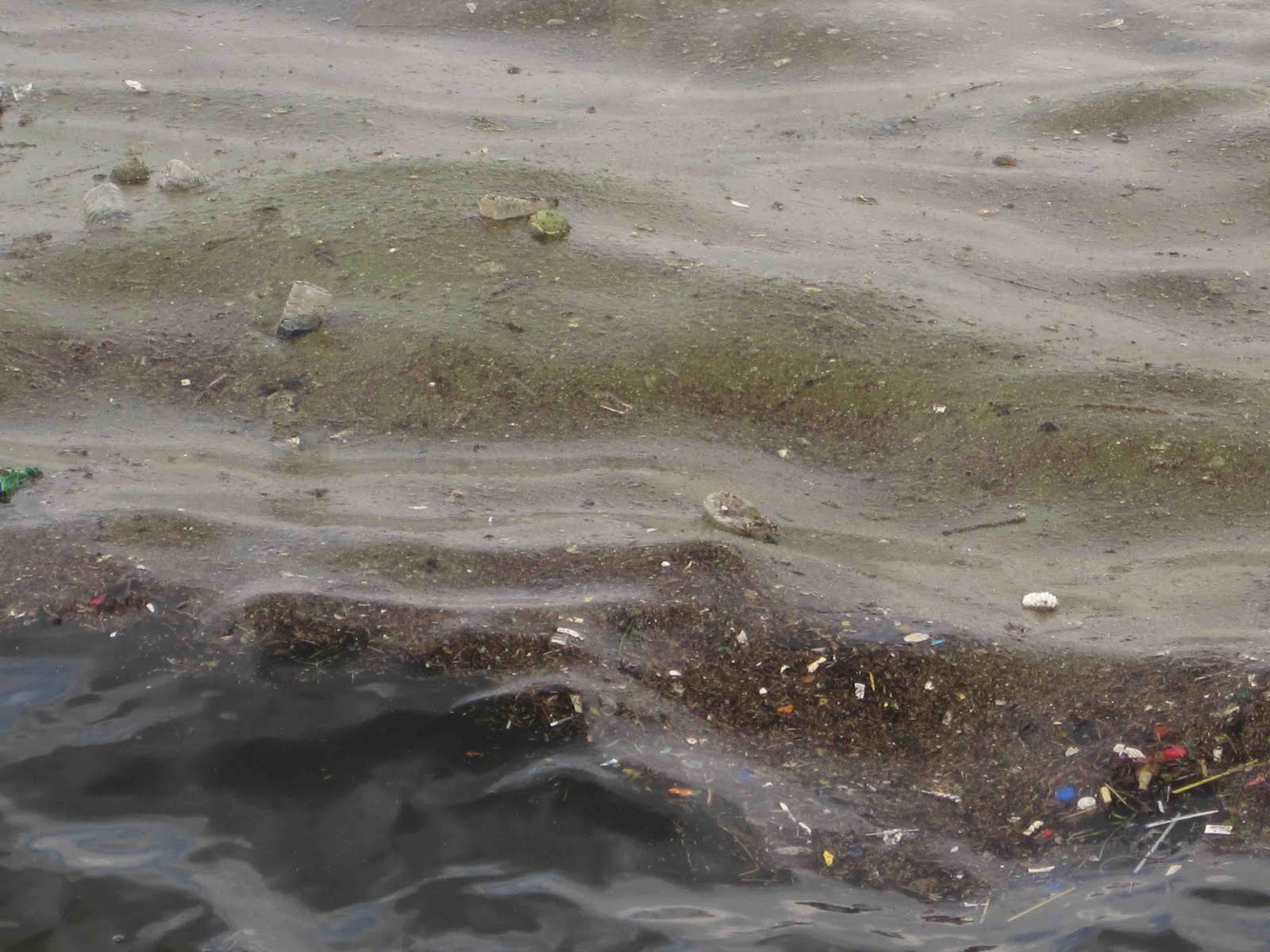

A floating glob of garbage, debris and
pollution, Lake Pontchartrain.


I am here to live within these premises as much as I can, to test them, become their experiment, to shed preconceive ideas and cut through the ever-arising array of my petty mind occupations; fear and contraction, self-abasement, naivety, blatant distraction and vanity. As in Chicago, here I received an e-mail that entered and altered my narrative. It is from another reader of my Journal,  Jeff Krouk, someone I have only recently met, on line, who reads my Journal, who has a website (with rare and fantastic footage of early Chögyam Trunga) and who wrote: 

The oil spill is a black swan event. its important that you are there. Very "naga serious." The spill is not really a spill. They busted a geologic artery. The spec's for the equipment that failed was not built to handle what happened and is now in progress. This is as big a deal as the financial meltdown and it is all playing into the same configuration of collapse and social unwinding we are experiencing... Within 3 years of Chernobyl the Berlin Wall fell and the USSR was gone. In three years the US may not be gone but we may not recognize it. If you can see the web cam images some of the web sites are running from the well head you can see what a catastrophe this is in real time with no end in sight. Even with all the news about the blowout continuing it still is being suppressed by omission and  coverage of other far less important events. - Jeff Krouk


Naga heads on path to shrine,
Chiang Mai, Thailand.


Body of Nagas, Chiang Mai, Thailand


Nagas are snake-headed beings, found in the mythology and religions of India and Southeast Asia, and are associated with water. The Shambhala teachings speak of "The Great Lu, Tsugna Rinchen" who might be considered a "mere" naga or potentially obstructing spirit in orthodox Tibetan Buddhism, but as a drala, Tsugna Rinchen represents the elemental wisdom principle of lu, which are the lowest elevations within any particular geography, hence where rivers and wetlands are, the domain of water. If one embraces water as being - or a being - then nagas (or Tsugna Rinchen, or any name that any tradition gives to water beings) are those who we participate with, as they participate with us (who also are largely water).

The only way I have found to "participate" with Tsugna Rinchen or the dralas of water is to go blank. "To have the capacity," as Ibn Arabi puts it, "to become a mother of what it presented." This is a very simple extension of meditation or resting the mind. In "going blank" (for lack of another term) one surrenders pre-conceived ideas and instead tunes in to space and the atmosphere of space, the intangible that surrounds us (as awareness, dralas, God). "Becoming a mother" means that space tells us what do do, (and what not to do)  and we give birth to that, which is manifestation.

Plastic bottle with oil. Photograph
of a newspaper photograph,
Times Picayune.


To be continued...

Sunday, May 16, 2010

"The ones that bring us the life force"

Cat's Eye.
This object reflects a stage of evolution our own sun will experience in several billion years. When a sun-like star begin to run out of fuel, it sheds some of its outer layers while leaving behind a white-hot core.


WATER

In 2004 I began a mode of life that is still occurring, one of travel (a mode which occurs even if travel is only to the mailbox) and one in which I felt I was becoming the "experiment of my own art." Beginning that year I had the privilege to travel internationally and it was always bodies of water that most attracted me: the River Arno; the Bosporus, the Mekong. Without necessarily intending to, I returned home with a far greater appreciation of water, so much so that I could barely stand to "waste" it and for a while carried my dish water to the garden rather than letting it simply go down the drain. 

In 2007 I read the book Water Wars by Vandana Shiva. In the preface I discovered this poem, which I committed to memory and have recited aloud nearly every morning since then:
WATER OF LIFE

Waters, you are the ones that bring us the life force.
Help us to find nourishment,
So we may look upon great joy.
Let us share in the most delicious sap you have,
As if you are loving mothers,
Let us go straight to the house of the one,
For whom you waters give us life and give us birth.
For our well-being, let the goddesses be an aid to us,
Let the waters be for us to drink.
Let them cause well-being and health to flow over us.
Mistresses of all the things that are chosen,
Rulers over all peoples,
The waters are the ones I beg for a cure.
Waters - yield your cure as an armor for my body,
So I may look upon the sun for a long time.
Waters - carry away all of this that has gone bad in me.
Either that I have done in malicious deceit,
Or whatever lie I have sworn to,
I hear sort the waters today.
We have joined with their sap,
Oh Agni, full of moisture,
Come and flood me with splendor!

The Ancient Rig Veda Hymn, Water of Life

In the fall of 2008, when I was completing my film, Denise: Circle of Blessing I took footage of water near my home, not simply as B-roll shots (which I never ended up using anyway) but as a form of healing; my mother had died in April and a month later I began to film the last three months of Denise Thornton's life. I edited the footage into a three-minute film that I narrated with the, Water of Life.


Prayer to Water from Bill Scheffel on Vimeo.


OIL SPILL

I am now in the third day of a twenty-day trip and writing from the twenty-eighth floor of a Chicago hotel. I was invited here over a year ago to attend the wedding of a friend and former student. A little over a week ago, I decided to abandon my return ticket back to Boulder and instead fly to New Orleans, so I could witness the oil spill there, come into its proximity, enter more fully into the narrative of pain. On Monday I will arrive there (thanks to aircraft and jet fuel). On Friday, I began the writing, photographic and video journal I intend this trip to be and am sharing here in its first installment.

In a long corridor leading from the terminal to the Orange Line train stop at Midway International Airport I came upon a series of photographs of our home, the universe. My wits, though dulled from the plane flight were still sharp enough to say: Stop, take pictures of these pictures!


Lagoon Nebula
So large and bright it can me seen without a 
telescope near the constellation Sagittarius.


Butterfly Nebula
3,700 light years from home.


Uranus
The seventh planet from the sun.


Saturn
2006 Cassini spacecraft photograph
as it passed behind the planet.


North America

I was hoping, quite wholeheartedly actually, quite wholeheartedly, that the drala principle would descend on you and become part of you... They are longing to meet you... So why on earth do you have to create a barrier to exclude the dralas from your life? For heaven’s sake, heaven and earth, can’t we just relax a little bit. And please, shed a few tears. That will help a lot.Chögyam Trungpa


Below is a very worthwhile interview with James Cameron director of Avatar on "evoking external drala" and restoring environmental sanity. View below or on the Democracy Now website. 


Friday, May 7, 2010

HUGE CHOICE EACH MOMENT

To begin this week, I'd like to invite you to consider writing on any of the subjects on this journal. Normally a "blog response" is an opinion about a topic; not that I don't welcome any response, but the idea of "writing" is slightly different, "You will write not if you think of writing as a result but as a discovery" (Gertrude Stein). Writing is about your contribution, your experience, and the freedom to offer that. 

Next, another video segment from an interview Cathy Hubiak and I conducted with Kunga Dawa (Richard Arthure).


Kunga Dawa on "transmissions" from Chögyam Trungpa from Bill Scheffel on Vimeo.


Drala “is the notion of personal bravery” (Chögyam Trungpa). Whenever we transcend fear we potentially invoke drala, which initiates a process of further bravery and protection from fear. This is not a magical notion in any esoteric sense, but simply a natural unfolding. The process is one of recognizing the non-conceptual and unconditional nature of experience, relating to the expressions that arise from the unconditioned ground, and opening to the coincidences that present themselves in daily life (and which are daily life).


Photo by Don Myer


The drala principle is:
  
H U G E   C H O I C E   E A C H   M O M E N T
 
A natural prayer or meditation practice:
1. Gaze at the sky.
2. Gaze at what is "below" the sky.
3. Gaze at what is in one's mind (or heart).
"Gaze" means don't just go on thinking, though don't try not to think, simply  become aware. 


People think, think, think; in all directions, but they think. The questioning gaze is rare. - Henri Cartier-Bresson.


Photo by Bill Scheffel


The drala principle spans theism, non-theism and the secular. The drala principle is experienced by those on the path of God, those of non-theistic faiths as well as in "secular" experience.

There is no difference between theism and non-theism, basically speaking. Declaring an involvement with any kind of “ism” turns out to be a matter of self and other. In fact, the whole question of self and other can then become very important. But if you really pursue any spiritual path, you will discover, surprisingly, that self and other are one thing. Self is other, other is self... Whether you worship someone else or worship yourself, it is the same thing…      Chogyam Trungpa. Speaking of Silence, pg. 153

Another aspect of any "ism" is that it is a thought, a held concept. Whereas non-thought is the gate of the dralas, that moment of atmosphere and immediate perceptual communication. I've spent a few nights watching a New Video documentary of Henri Cartier-Bresson, who seemed to always click the camera shutter the moment the gate was open. There was footage of Cartier-Bresson shooting; he wandered around very casually, with the camera in one hand behind him, somewhat hidden. Others on the street were looking at where they were going whereas he looked at what was happening. 


slowness, more tears, WATER

Waters, you are the ones that bring us the life force.
Help us to find nourishment,
So we may look upon great joy.

           - Rig Veda Hymn, Water of Life

Below are more photographs from my friend Don Myer (gassho!). The first three were taken at Coney Island, the last one at Fort Funston, San Francisco (if you click on them you will see them enlarged).


HUGE CHOICES, HUGE CONSEQUENCES

Environmental sanity. Is there a disconnect between our "spiritual" lives and "activism" or taking individual responsibility for collective problems? Collective experience is the cumulative wave of each our our "karmic" contributions (regardless of how "spiritual" we are). Thus the oil spill in The Gulf is a collective fault, a collective horror, a collective challenge, a collective responsibility (could the latter become possible)? 

The drala principle teachings (so to speak) attract me because they provide a link between spiritual, social and environmental responsibility.

In the spirit of this theme, I offer you a video interview with the journalist Charles Bowden on his book, Murder City: Ciudad Juarez and the Global Economy's New Killing Fields. Bowden addresses many political issues - NAFTA, the war on drugs, immigration, gun control - but I offer it also as entertainment. What we take the time to see should at least be interesting in its own right, no? Charles Bowden is interesting. He has dug deeply into these issues, lives them, has been warped by them, has something to say, a kind of film noir Mother Teressa. The piece offers one person's researched description of a "collective karma."

Click here to watch on the Democracy Now website.


Friday, April 30, 2010

SLOWNESS, MORE TEARS (and Lineage)


This week continues the themes of slowness, more tears (and adds the theme of "lineage"). It begins with a package that arrived on Monday that looked so big for a CD. Wasn't until I opened it that I realized I'd purchased the vinyl version of Dengue Fever Presents: Electric Cambodia. So I got my parent's turntable out of the storage locker and gave it a spin...

The drala principle like the out breath is analog, orbits at 33 and a third and can decorate the walls if the grid goes down. Finding the beginning of more tears wasn't hard watching the album spin on the dusty turntable and suddenly feeling my body thirty years ago, before answering machines, cell phone radiation and light emitting diodes. The digital stimulation we carry in our nervous systems is a shared subtle suffering, a speed up and faint daily torture. I long for my manual typewriters yet have committed myself to the Macbook screen. 


. . . . . . . . . . . . . . 


On Tuesday I received an e-mail from my longtime friend Don Myer (who has been helping me edit an article I'm writing; Don can spot a typo across the room whereas I can be looking at one for three minutes and still not see it). Don has journeyed from a house stocked with bone white dinnerware, Bose CD players and other gizmos to homeless though not broke mendicant (he sold house and has the proceeds) to moving back in with his mother to shepherd her as best he can in advanced old age and dying. He takes care of her body and declining mind, along with his now sick and dying dog, Pele. Don has offered me countless meals and a place to sleep and his daughter Haley and my son Devin (both now age 26) were born within three months of each other.

Don Myer, 2009

Don is a generous and genuine human being and I adore him. This selection from his e-mail shows the sense of humor, curiosity and empathy that must be the weave of the human heart; a three-fold coil of joy that allows us to confront it all:
Thunder and rain here as I watch my procrastinations all evening to get down and read the article with note pad in hand. Twice I fell into a deep slumber, laptop a warm blanket but still feeling the exhaustion of my almost all-nighter. Pele shit right near me. It was the largest thing I'd ever seen. Like some alien movie. Poor thing. The disease makes her voraciously hungry and thirsty and she has access to unlimited dry food that usually she is not that interested in. That got my attention and woke me.
Don teachers Kundalini Yoga and is also a photographer. He worked many years in commercial photography and his own photographs are universally admired among his friends and family. He stayed up all night, getting around to editing my piece and finding some photographs - both "found" photos and his own - that  I could use on this site. I don't really know the history of them, or if he's given them names (so I've used the JPEG titles)


House, Ice, River


New Egypt Hudson


These previous found photographs, in Don's words: "The first two images you used in today's journal were from a beautiful old picture album from the twenties. I love the image of the woman standing on the banks of the frozen lake. I wanted to blow it up very large (6 feet?). I have made many pictures like it.


Moon


Blur Branch


Man Skater

The vertical

What I notice in the selection of photographs Don sent me, along with their obvious shimmering sensitivity and non-invasive touch, is their verticality and angles. In House, Ice, River and New Egypt Hudson the verticality of trees; in Man Skater, that of the human body. These verticals, photographed into the exquisite portraits that they are, echo the theme so articulated in Chinese thought, joining the earth and the heavenly spheres, which is a north south, vertical movement, a cosmic stroke.

My friend Tom Pathe, lifelong rolfer and meditation aficionado (led by "the drala principle" into deep investigations and insights into the "inner" dimensions of the human body) made me aware of 45 degree angles  (as do all of Don's photographs, but especially Blur Branch). These angles, it seems, are universal aspects of awake as well as drala-delivery systems; they include the natural aesthetics of nature, lines in the human body from, say, the sternum to the sacrum, as well as the angle of the vagina and the erection (for those familiar with the Ashe practice, consider that also).


Lineage

Finally this week, I offer something on the theme of "lineage." Another friend I am fortunate to have is Jim Yensan; reader, gardener, photographer, father, adjunct professor of meditation at Naropa University and "Mac Therapist" (he recovers lost files, solves printer glitches and saves computer neophytes from themselves).

 
Jim's vegetable patch

Jim is a lifelong student of Chögyam Trungpa and in the five-minute video clip below, Jim talks about first meeting Chögyam Trungpa in the early 1970s as well as first beginning to teach Buddhism. This is a story about lineage; making a genuine connection with a lineage and lineage holder, and about trust, how lineage establishes or restores trust in ourselves. Here is an inclusive definition I gave to lineage on my website:

A lineage, as the word is used here, means any tradition that evokes and propagates drala. A painting, say, of Cezanne is loaded with drala. A man like Cezanne does not simply happen, but is someone who received the training and inspiration of countless ancestors before him and then put what he received into practice. That Cezanne apocryphally painted until his eyes bled is a measure of the work and sacrifice required to become a great lineage holder. Spiritual or religious lineages have no doubt produced our greatest lineage figures, but the path of drala cannot be defined as strictly sacred or secular. It could occur wherever genuine goodness and devotion are manifested. We might not even realize the lineages we are already part of; anyone who has ever read a poem has made contact with one of humanity's most universal, primordial and wonderful lineages.


Saturday, April 24, 2010

SLOWNESS, MORE TEARS, WATER


"My first sight...

My first sight of Cambodia came from the window of a Russian Y-9, an aging prop-jetliner that departed from Bangkok. Through the round window I saw Cambodia and felt a kind of urgency that said, “Look, I’m seeing this for the first time!” I saw mostly forest, brush, an occasional road. Then fields, terraced and delicate. Roofs of corrugated steel. Palm trees, white oxen. No water.  -  Phnom Penh 11-Feb: 2005

I wrote the above during a three-month “pilgrimage” I took in late 2004, a trip that took me to Italy, Malta, Turkey and Southeast Asia. Shortly after my return to the United States I taught a weekend meditation program. On Sunday afternoon, at the end of my final talk I decided to let myself have no idea what I would say next. I said that to the group, “Now I’m going to say something and I have no idea what it will be.” Four words came to me and I spoke them aloud: slowness, more tears, water.

Now, five years later, these words are a kind of root for everything I do, or fail to do, or want to do. Also a root (route) for wherever it is I am going.

Slowness. John Cage advised us to “quiet the mind, thus making it susceptible to divine influences.” Chögyam Trungpa said, “The most important thing one could ever do for oneself or others is to sit down and unravel the confusion in one’s mind.” The Slow Food movement believes taste, nutrition, pleasure, community, sustainability and social justice are all indelibly linked by the word slow.

In Bangkok I began to witness an uncanny lack of haste in an otherwise apocalyptic megalopolis of thirteen million people and countless hurdling vehicles. Yet within all that, people walked quite slowly, very naturally and beautifully. I began to witness an elegance my own body was seldom capable of. It was only when I began to walk more slowly myself that the invisible dunce cap I felt myself wearing vanished from my head.

One can talk very fast and still be slow, or run quickly and be in slowness. It is a matter of staying connected to the dralas, that intangible feeling or atmosphere and presence that is always available to us.


As for the second word(s), more tears, I will let this video segment speak for that. It’s a YouTube find, a piece about Cambodia and is bit long, twenty-three minutes (with an awful commercial in the beginning). It is a document of the tremendous pain inflicted through haste (you could say), the quick grab for profit none of us are immune from reaching for. It brings home the situation for many in our world-community. I guarantee it is rather unique and stunning and the necessary stuff of more tears.

Cambodia Land Grab - Is Cambodia's Prime Minister behind an illegal land grab? All over the country, hundreds of thousands are waking up to find the homes they owned have been sold to developers. 


Water will come in future weeks...

Friday, April 16, 2010

NON-DECEPTION


"CANDOR ENDS PARANOIA"
 - Allen Ginsberg


This week I will speak on an aspect of the drala principle called “not deceiving.” I say “speak” because, as in normal conversation, we don’t exactly know what we will say next, nor do I know what I will write next. In that spirit, I am not an expert on the drala principle (which at best would be a silly thing to claim) but a contributor, a gatherer, an explorer.


Truth-telling

Chögyam Trungpa taught that the dralas are attracted to us or “invoked” when we tell the truth. On the one hand, “telling the truth” is often a dubious expression of our opinions (always relative) or ideology (often dubious and dangerous). The truth he meant – the truth the dralas are drawn to - are things such as candor, simple emotional honesty and “naming the path of our heart.” The latter is typically only vaguely known to us at best, but if we don’t speak, it stays hidden. Telling the truth is often about disclosing things that are not convenient to say; speaking up when we see injustice or simply not lying to our partner, children or parents.

Truth-telling is also the principle that runs through art, all the arts. As Vietnam Vet-poet Bruce Weigl wrote, “Say it clearly and you make it beautiful, no matter what.”


Two accidents crossed my path after I chose this subject. I received an e-mail from a friend, AnaVictoria Pabelon who lives with her husband Seth and two children in Fairfield, Iowa. Earlier in the week I e-mailed AnaVictoria and asked how she was.  AnaVictoria replied to my e-mail with a generous, thorough and effortless candor. She and Seth were kind and daring enough to let me share what she wrote:


I am well indeed. I think back to when I was in Colorado and I am very grateful everyday. I feel like I escaped from a massive human prison called Civilized Western World. I enjoy technology more than ever and Eastern practices are my refuge from the overwhelming aspects of my culture yet a challenge to maintain because of my conditioning, so overall it has been an intense time of purifying and serving. I so love that I have had the time to focus on rearing my children. The laundry, the groceries, the inflow of mail, and stuff is both tedious and lovely. I am not searching for meaning or God anymore. It is bliss. I am here struggling to get up in the morning not because I dread the day’s tasks, but because the silence is yummy and so is the stillness and so is listening to the birds once they get started. And because I love just about everything, my thoughts, my stories, my joy, my suffering. I am in very good health but in delicate condition. I have crying spells, lots of involuntary twitching and facial muscle release, there are no particular reasons, so I am able to carry on as normal. My family is both amused and bored with the whole thing. The girls are doing great , though Marisol goes to preschool for three mornings a week, I am homeschooling both Paloma and Marisol. This has been fun for all of us. Things are also going well with Seth. He is sweet and kind, generous and supportive and grateful. It is a good connection and I have to admit I look at him and I hardly ever see Him. I understand that I see a male collective that I misunderstand and do not trust, so mostly I have to see him anew each moment and go by feeling him and then seeing him, because just in looking at him I can not recognize the essence of him.


Alice Walker
 

In the second accident I came upon an (Amy Goodman) interview with with Alice Walker who has much to say about the process, reasons for, demands of and necessity for truth-telling. It is not only in the subjects alone that Alice Walker speaks with candor and truth, but equally in the inner-truth she lives by, one that seems to compel her to become ever more keen, modest and sensitive.


Jakusho Kwong Roshi


What follows is a letter from Soto Zen lineage holder Jakusho Kwong-roshi, recently sent to his students and friends. Roshi speaks the truth of dharma - the clearest, most unmediated and most direct expression of things-as-they-are, the simplicity of non-deception.

S  O  N O  M  A   M  O  U  N  T  A  I  N   
Z  E  N   C  E  N  T  E  R
 

April 5, 2010


Dear Mahasangha,

On March 18, about 2 weeks ago, I felt excruciating pain below my abdomen and lower back.  Red welts began to appear in that area.  After a few days, I went to Kaiser emergency clinic, and I was diagnosed with a severe case of “shingles”.  It is extremely painful, and it is known that it flares up because of stress.  My Chinese herbal doctor had warned me for the last ten years that my immune system has become weaker and weaker, and had advised me over the years to cut back on my responsibilities at the Zen Center and also my travels to Iceland and Poland.  I didn’t heed his advice, so now I am suffering the consequence.
Behind the illness—it’s deeper and mysterious.  The Dharma appears in this way—it feels like a Rite of Passage.  Dealing with intense pain moment after moment challenges my whole being, my spirit and wisdom.  I am so grateful for Zen Practice.  I can’t imagine how others can endure without this wisdom of acceptance.  I suppose some people manage to find it within their resolve towards greater acceptance.
Alone in silence, I see the beautiful oak trees, the madrone, the tall pines— the most brilliant Gold in 37 years, ushering Spring.  Even they have to endure the cold winters, rain, strong winds, heavy storm before their renewal.  It is their passage of change.  It feels like labor pains before the birth of of something new---deep presence, intense pain, breathing—demanding change and renewal on a cellular level.  The Dharma is wondrous and inconceivable—cannot be located or seen.  In this way, whether I am here or not, I am always with each one of you.  You will find that this is true. I urge you to step forward and renew your Zen practice with spirit and vitality of Sonoma Mountain Sangha.
There is nothing more essential that you can do in your lifetime.  It will help you to actively  accept and receive the unknown that is yet to come whether it is negative or positive. True zazen is the expression of your Buddha Nature.  With constancy it will prepare you for everything that you will encounter.
I’ve been listening to this Gaelic Blessings that was inspired to put into music.  I listen to it every day, and it penetrates me like the repetition of a mantra.
DEEP PEACE of the running waves to you

DEEP PEACE of the flowing air to you

DEEP PEACE of the quiet earth to you

DEEP PEACE of the shinning stars to you

DEEP PEACE of the gentle night to you

MOON AND STARS pour their healing light on you

DEEP PEACE

In gassho,
Kwong-roshi

Shinko helped me edit this.

6367 Sonoma Mountain Road  Santa Rosa Ca 95404    707/545-8105  smzc@smzc.net