Thursday, May 5, 2011

Tribute to Eamon Killoran


(Eamon Killoran became a member of the Buddhist community founded by Chögyam Trungpa Rinpoche in the 1970s. Eamon and I met in this community and maintained a thirty-five year friendship until his death, April 18, 2011. He was a devoted practitioner of Buddhism and all things related to the drala principle. - Bill Scheffel)


The photograph above shows Eamon Killoran eleven months ago. A few weeks after this picture was taken, Eamon learned he had cancer. In less than a year he was dead. I took the photograph of him in Portland, Oregon, soon after I had arrived for lunch at the home of mutual friends. My first impression of Eamon was his beauty. That a transparency had come to his complexion - as it often does to people well into their seventies.  That his beard and his eyebrows were now the same luminous grey. That he smiled with his familiar stature and sense of reserve, but none-the-less, extremely warmly. I had the feeling of falling in love with him, as if in this moment our thirty-six year friendship was being restored, renewed, amplified. 
 
Eamon looked you in the eye and spoke – it seemed -  with his jaw slightly clenched. His words were typically few, often emerged reluctantly and were astonishingly compelling. On the one hand you felt you had to converse honestly, that his long silences might set you up to make a fool out of yourself or at least display a fumbling frivolousness. On the other hand, what he had to say seemed to come like something out of Melville, a story or confession that becomes enthralling in a hurry.

Over lunch we were reminded that Eamon’s first wife was a member of the Black Panther Party (they had two children together). Eamon loved literature and it was stories like these that made me want him to write his own memoir. Eamon’s father was an Irish cop operating in the more corrupt strata of the New York City police department. One day, his younger brother, barely old enough to walk, discovered their father’s loaded revolver and accidentally killed himself. Alcohol, firearms, gambling. By adolescence, Eamon was faced with the conscious decision to become a criminal or not. As a young man he wandered widely, one day getting a job on a ship. He went on to serve as a merchant seaman throughout his adult life. He understood exactly what had happened on the Exxon Valdez since he had served for decades on similar tankers. 
 
Eamon and I entered the dharma in California, shared countless programs at the Berkeley Dharmadhatu, went to seminary one year apart and became Kusung (Tibetan; personal servant) together in 1980. We waited together, alternately nervous or giddy and with a sense of impending joyous doom each time The Varja Regent or The Vidyadhara was about to emerge from a gate at San Francisco International Airport. We performed the same Kusung tasks: bringing our left arm under The Vidhadhara’s right so we could assist and steady him as he walked. We helped choose suits from his wardrobe and put on his socks. We filled our minds with every detail we could – the day’s schedule, its meals, who wanted an interview - before beginning a shift and then spent the next twelve hours in a concentrated free-fall, a near lifetime spent in very awake and orderly chaos of a day (or night) with Chögyam Trungpa. 
 
It was this history, at once long ago and primordially imprinted in my heart that brought me to write what I did after learning by phone, two weeks ago, that Eamon had died: 

With his passing I feel my own life evaporate: its traces, the countless sacred impressions and tracks of our gurus, that they literally walked along side us, took water from our hands, even kissed us. These traces are as beautiful, profound and mysterious as the nebula we see through our telescopes. Flaring. Awesome. Where do they go?
 
The living presence of The Vidyadhara’s love carried Eamon on a very steady devotional course. Perhaps spending nearly six-months a year at sea helped keep his remarkable marriage to Michele very alive. It certainly gave him a lot of time to practice – and to be very alone with The Vidyadara’s mind and teaching. One might know the way The Vidyadhara loved Eamon by understanding how Eamon loved The Vidyadhara - but who can describe unconditional love? If I had to venture a guess I would say it was because of Eamon’s reliability, a particular form of Chögyam Trungpa’s own elemental ethos, the bond he had with all of us: never give up. 
 
It must have been Eamon’s reliability that created a trajectory from his tough, early life, through to the end, his cremation at Shambhala Mountain Center. I was in Boston when I leaned Eamon died and I was not able to attend the event, but our dear mutual friend told me a flock of seagulls appeared out of nowhere when Eamon’s body was removed from The Great Stupa of Dharmakaya in the morning. I told her a flock of seagulls is as astonishing as the circular rainbow that appeared at the Vidyadhara’s parinirvana! 
 
Eamon remained a devoted father to Meadow and Zackary, the children from his first marriage. When he married Michele in the mid 1970s they formed a union and a household that was home to Eamon’s children and to Lucas, Michele’s son from her first marriage. The household became a court when The Vidyadhara stayed there, as he did numerous times. When Eamon and Michele moved to Shambhala Mountain Center in 1991, Eamon began a four-year tenure as SMC co-director, along with Catherina Pressman. Sakyong Mipham Rinpoche selected Eamon for the job and Eamon remained actively involved in The Sakyong’s service and Shambhala Mountain Center for the rest of his life. 
 
Within this outward life of reliable service, Eamon did not seem a man doing things merely because he felt obliged to, even less the follower of a party-line. In late 2003, I spent an evening with Eamon a few months after Michele died. I could feel the world he inhabited; that his home was genuinely at the Buddhist community’s service, that he practiced Chakrasamvara sadhana intently, that he was alone and semi-shattered with a diverse stack of books and that there was a bottle of Scotch on the table between us. I felt the challenge, as I always did, of disclosing something genuine as we talked. I felt back-up against the wall by his even more penetrating silences and matter of fact description of what life was like without Michele. I don’t really remember what we talked about, but unlike so many other conversations I’ve had over the subsequent eight years, I remember just what it felt like to be with him, simply spacious and true. 
 
Last fall I began corresponding with Eamon from Istanbul, a city he had spent time in as a young merchant seaman. I wrote about my “psychic crush” – not an infatuation, but the way I often felt having my mother and father die in the last three years, as well as having just about every other damn part of my life fall apart in this time. Eamon wrote back, telling me of his own psychic crush:

 I think I've been living with it to various degrees since Michele's sudden going. I never really finished packing away her things, just did some more of that recently.  Part of that is laziness, inertia, some of it just waiting, living, until it's obviously time.
 
He also wrote to me about writing (I was still after him to begin his memoir):
I make small movements towards writing, then get overwhelmed and lastly stopped at the point where I didn't really know whether I wanted to tell the truth or not.  Or try anyway.  That movement also keeps getting placed on hold as different dharmic activities demand most of my time, and then and then . . .

From Istanbul I also wrote to Eamon about seagulls (a man who’d  seen his share). After living in Istanbul, one can hardly think of the city without seeing seagulls or hearing their cry. I wrote to Eamon, pointing out that as we humans  overrun the planet “the animals that remain survivors in our midst seem like analogs, as if a dialog is going on if we could listen or observe more closely.”

When I wrote that sentence, I didn’t really know what I meant by analogs - but a few months later that flock of seagulls appeared above Eamon’s body. 


Eminönü Ferry, Istanbul

Sunday, April 17, 2011

ANCESTORS & VERTICAL TIME


Basilica of St. Mary Magdalene,
Vézelay, France.


My mother, Alice Scheffel, died on April 17th, 2008 - exactly three years ago -  and I am suddenly finding myself preparing a blog entry to acknowledge her on this day, an inspiration that came to me only an hour ago. In presenting this entry for my mother, perhaps it will become a moment for readers to remember, and feel the presence of, their own ancestors.  

. . .

Several coincidences align to present this tribute. The first, that my mother maintained her lifelong connection to Christianity and to the inspiration of Jesus, while also throwing off what had become for her the dogma of the church - in her case Episcopal - which eventually meant no longer attending church or particularly reading the bible. Instead she turned to authors who had also chosen to speak beyond the confines of doctrine - Bishop John Shelby Spong, for instance - and embraced an affiliation with Buddhism, a sense of kinship and ease with the teachings of Thich Nhat Hanh and Chögyam Trungpa in particular. She faced death with a confidence and even, I must say, a sense of celebration I am still in awe of (and only wish I could write more about now.)

Another coincidence is that in 2004 I traveled a route through northern Italy partially designed to see the frescoes and paintings of Piero della Francesca and in particular his fresco of Mary Magdalene, a work I had so long admired in reproduction that it had nearly become a deity and altar in my room, the expression of the feminine I most adored. 

Last year - through a thicket of such coincidences I can still hardly believe them - I found myself traveling with a friend to the Basilica of St. Mary Magdalene in Vézelay, France. It was inside the church that my long-standing admiration for Piero's Mary merged with the atmosphere of one of the most beautiful (and living) buildings I'd ever entered. It was inside the church that I also had an encounter with my ancestors, my mother and father (my father died last August). A few days later I wrote about my time there:

Late in the 10th Century, a monk named Baudillon brought bone relics of Mary Magdalene to Vézelay. in 1050 the Pope confirmed them as genuine and for these subsequent 1,000 years a continuous stream of pilgrims, including Richard the Lionhearted and Thomas Becket, have made stops here. A crypt in the Basilica holds the well-lit relic, a bone fragment that looks like it came from a leg or arm and also resembles a spear.

A spear can represent vertical time, but so can a six-inch long piece of femur. If a bullet was shot through a telephone book the hollow path of its trail would be a vertical but invisible spear penetrating each of the hundreds of pages of the book (and on each page hundreds of names). In the same way, hundreds of qualities of Mary Magdalene have come to make “Mary Magdalene”. It is the qualities that Mary evokes in those who think about her that make her Mary. 

Detail of Piero Della Francesca's
Mary Magdalene. Arezzo, Italy.
During my inspection of the church,  I deposited four Euros in a cash box in exchange for two votive candles, lit them, and stood in front of another Mary Magdalene, this one a stone sculpture depicting Mary comforting a baby. I lit and offered the candles for my parents, Alice and Bill. I wasn’t sure which verb tense to use as I prayed for my parents who felt with me (present), behind me (past) and in front of me (future). When I thought of how much they would have loved seeing this basilica my heart was heavy in the same way it was when I thought of how I could never tell them I was here. Thus I proved to myself that time as quantity is heavy, even a burden and tragedy. But the atmosphere in the room was thinking in vertical time, which made it completely possible to realize my parents are in my present, past and future at once. 
Basilica of St. Mary Magdalene.


 Alice Scheffel, spring 2007.


Alice, one week before she
died (on April 17, 2008).

Saturday, March 5, 2011

Sympathy


All the dreams you show up in are not your own. Gil Scott-Heron

 
Demonstration in support of Egypt uprising,
Portland, Oregon.

Pleases enjoy this video on what the Arab revolutions mean.

I extend my apologies for my long and unannounced gap in publishing The Drala Principle. In short, travel and engagement with the subjects I write about became so compelling and at times demanding that I could not write, only experience and assimilate. Since the end of October I traveled with a friend through central and southern France (a pilgrimage to sites we felt called to visit) then spent five weeks alone and on retreat in Istanbul (a retreat both in my hotel room and through silent wandering on the streets). During this time I realized I must sell my home and most of my possessions and resume life from a suitcase. In the past three weeks, post-home, I have traveled to Portland Oregon, Minneapolis, Washington D.C., New York City and Paris, where I am now, staying with a friend (as I have stayed with other friends along the way).

a home is

with bank account
though still going

homeless

no shrine
no photograph
no return ticket

I live in the abode
of friendship

which is the home
each friendship
occurs in

when seen
from a distance it is:

a dream
yet a house
an atmosphere
yet also a body
 

26-Feb: 2011
Paris


I suppose like nearly everyone, I have been moved by the popular and decidedly non-violent demonstrations/revolutions in the Arab world. I took the photograph above in Portland Oregon, a moment when my son and I came upon a rally in support of the people of Egypt. Perhaps the photo captures the same feelings of pride and determination, courage and joy that so animated the footage we saw from Tahrir square. 

The next day I witnesses something else that reminded me of Tahrir. As I was waiting for the airport tram, a well-dressed man standing beside me began to pick up garbage, first a discarded beer can, then the fallen newspapers, plastic bags and litter of the entire block, which he combed methodically. I felt inspired by his act and slightly ashamed I hadn't seen fit to do the same. When he returned to the stop beside me I thanked him. I told him his act reminded me of Tahrir square and what was perhaps most inspiring of all, that the people there and in other parts of Cairo performed their own spontaneous security patrols, emergency assistance and garbage collection. A generous, caring and sympathetic camaraderie - that was impossible not to sympathize with. Perhaps the way toward a more democratic and humane future for all of us.

It is in this spirit that I salute all of you on this day, which for many is also a New Year's celebration, that of losar, Tibetan New Year or Shambhala Day. 


Luxembourg Garden, Paris


Thursday, October 14, 2010

PRINCIPLES OF DHARMA ART

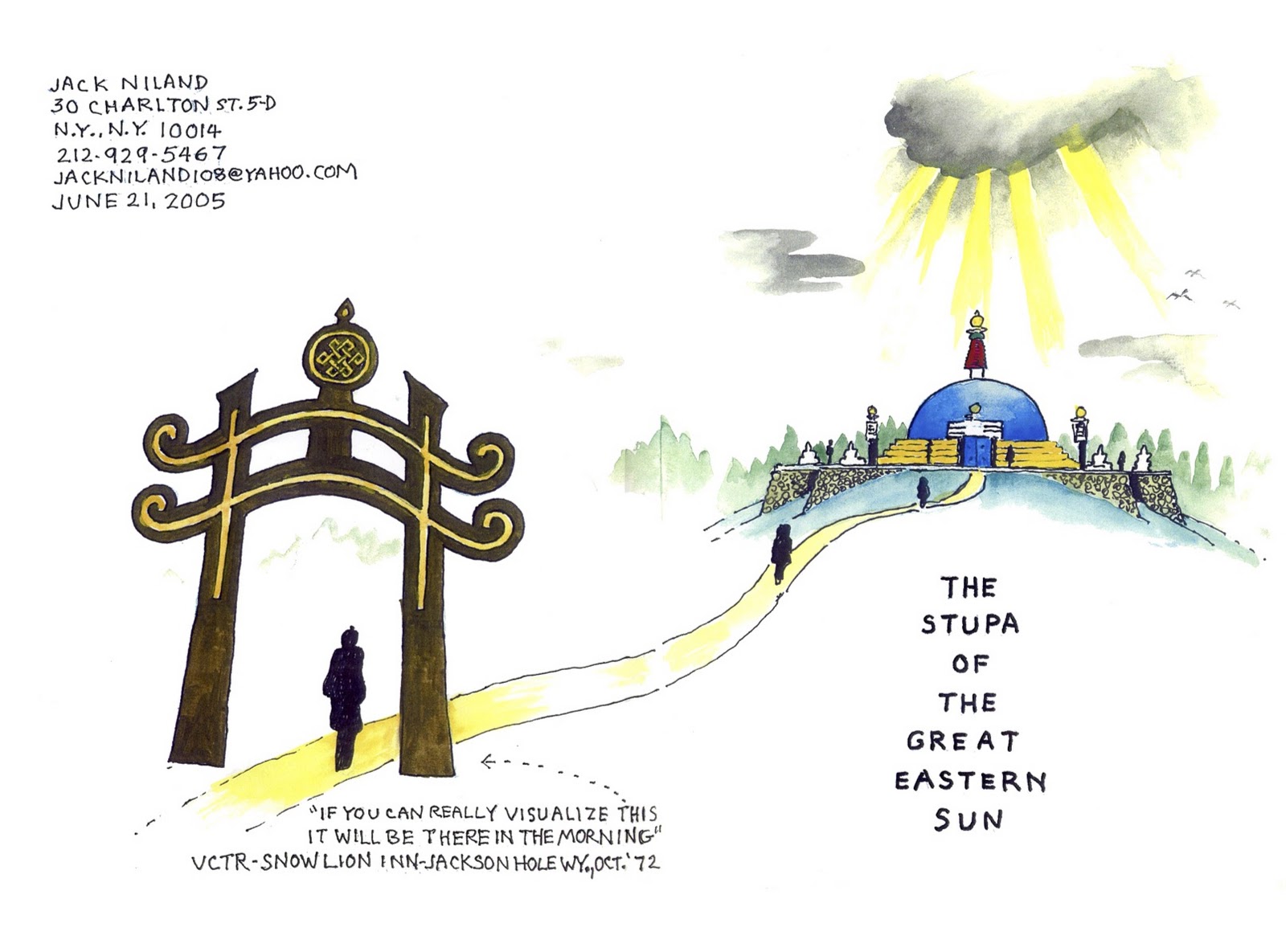
"If you can really visualize this it will be there in the morning"
 

Drawing by Jack Niland.
"If you can really visualize this it will be there in the morning." Venerable Chögyam Trungpa Rinpoche. Snow Lion Inn, Jackson Hole, Wyoming, October 1972.

The first book of Chögyam Trungpa’s that I read was his first book of teachings in English (besides his autobiography, Born in Tibet), Meditation in Action. The year was 1970 and I was a Sophomore in High School. I had already had my LSD experiences and carried the book around in my back pocket as an emblem of a new, emerging identity (as I carried books by Alan Watts and Albert Camus), a cognoscenti of the spiritual search, no longer dropping acid or eating meat. Over the next six years, I acquired other equally stimulating and confusing identities, for a while forgot about the book and its author. In 1976 I stumbled into one of his meditation centers, met Chögyam Trungpa a few months later and studied at Naropa Institute that summer. That first, single year was such an acceleration of the real and the possible, such a collision between myself and the irresistible and overwhelming world of Chögyam Trungpa, that 1976 alone could be a year to digest, practice with and be in service to for the rest of my life.

 Jack Niland in his NYC apartment.


Jack Niland, Dharma Art International Treasure

My meeting with Jack Niland two weeks ago was a kind of re-union with 1976 or, I might say, 1976 required me finally to have this meeting (no more than an accident). That summer, Jack taught a four-week class on the “dharma art” principles he had learned from Chögyam Trungpa. I sat on the floor with the seven or eight other students and listened to Jack’s lectures, his pure, smitten and unflagging enthusiasm for such things as how the rods and cones of the eye corresponded to the design matrices of Tibetan thangkas, how the earth was a “rinky-dink” planet compared to many other world-systems, how a dot was the first work of art and how the aesthetic and moral catastrophes of the late nineteen-seventies could be transformed into wakefulness through art – all of these, teachings and tales conveyed to Jack by Chögyam Trungpa.


The class did drawings and other "dharma art" exercise and I took copious notes. My notebook probably contained at least an outline of everything Jack had received from CTR, but a few years later I somehow lost it. I still think about the notebook and still feel its loss. 

Jack Niland's design for the 40th anniversary celebration
of Karme Choling (originally called Tail of the Tiger).

Earlier this year, I received and invitation to write an article about Chögyam Trungpa for an anthology on “artists of the Counterculture.” In the beginning of the article I described Jack’s story of first meeting Chögyam Trungpa, which can be heard on The Chronicles of CTR - (PLEASE listen to this recording!) 
At that time, Jack Niland, a young aspiring artist from suburban New Jersey was about to become one of Chögyam Trungpa’s first students. Niland, though just back from living in San Francisco’s Haight-Ashbury and after countless LSD trips, still had no satisfying insight into striking moments of perception he’d experienced as a child: how, for instance, an electric fan clipped afternoon sunlight to produce mesmerizing geometric designs inside his eye. Even the beauty of a schoolgirl in his first-grade class lingered as a haunting apex of the real. Niland not only wanted to reproduce such moments, but to understand them. Academic studies left him bored and feeling sidelined; Niland wanted personal access to the doors of perception. He’d had studied at Cooper Union and conversed with Jerry Garcia but had not found answers to his questions. He was about to take yet another road trip when his sister told him, “Jack, The Dalai Lama has moved to Vermont.” 

“Cool!” Niland said, “We’ll visit him on our way to Canada!” 

A few days later, Niland found his way to “Tail of the Tiger” a fledgling, semi-impoverished spiritual community in northern Vermont with a young Tibetan teacher in residence, a lama who of course was not the Dalai Lama but thirty-year old Chögyam. Niland knocked on the front door of the farmhouse which was the living quarters of the community and was forthright ushered to a small room where Chögyam Trungpa sat by a table with a pad of drawing paper, a brush and a bottle of India ink.
Jack Niland and Tao, when Jack met Chögyam 
Trungpa in 1970. Photo by Roland Sherman.
“There was this little Tibetan hippy guy, this cherubic guy with long hair and a huge grin, Niland recalled, “who looked up and said, ‘Oh, I’ve been waiting for you!’”

Trungpa, with “radiant energy and unbelievable charisma” immediately enlisted Niland to assist him in making his “very first work of art in North America,” a calligraphy of the Tibetan syllable Ah.  As he drew the syllable, Trungpa called Niland's attention to the “dot,” the first moment when pencil, pen or brush meets paper, which is not only the beginning of any line but also the moment form materializes from space. Trungpa called Niland’s attention again and again to the significance of the dot, how the dot is the first moment of arising in space, how the dot is in our hearts, how our mind is a dot. The splash of India ink is really the center of the cosmos.

As he was listening to Trungpa, Niland realized he had found someone who understood the phenomenology of perception. When he mentioned his experience with the fan, Trungpa replied, “Sure, sure, I understand, those colors come from the rods and cones in the eye. Tibetan thangkas are all based on that.” For Niland, Trungpa was the opposite of art history lectures and theories of aesthetics. Sitting in that room with him, Niland had no idea who Chögyam Trungpa was, he just knew Trungpa wasn’t explaining electricity but handing him the current. The syllable Ah, Trungpa added, means what it sounds like, a baby’s sense of wonder. If the Ah, a “pre-thought” and innocent moment of surprise, astonishment, even shock, was Chögyam Trungpa’s first work of art in North America, it was also the signature of his behavior, what it meant to encounter him.
.  .  .  .  . 

The First Western Thangka

A thangka painted by Jack Niland 
according to Chögyam Trungpa's instructions.


According to Chögyam Trungpa, this is the “first Western thangka.” It is a portrait of Sara Kapp, an early and close student of Trungpa’s, who was also Jack’s romantic partner for many years. Jack painted the thangka in the fall of 1970 according to Trungpa’s instructions.

Chögyam Trungpa fully believed in developing “Western thangkas,” works based on the discoveries of Tibetan Buddhism and Tibetan painting but in no way requiring the wholesale importation of Tibetan iconography. A fully-functional Western thangka would have to utilize images that arise from the Western psyche; or, we could say, from the “first thoughts” of the artist-practitioner. As I wrote last week, Images arising from our unconscious - from space itself - are not yet tethered to our hopes and fears, but can represent pure moments of meaning or "first thought." The valid image of, say, a wrathful deity could as easily be that of a Hell’s Angel on a bike rather than a red demon with multiple arms. 


To appreciate that a thangka could be Western and still convey  sacredness one, of course, needs to go no further than Giotto, Vermeer or Jasper Johns. But the principles of dharma art are an every-person’s art in that (visual) art emerges from a primordial language of mind and cosmos, a language it is impossible not to possess and that becomes evident even in the simplest of diagrams or drawings, if we know how to associate with them.


Drawing by Jack Niland.

In a sense, these diagrams are little more than doodles, but just as it is impossible not to have narrative in writing, it is impossible not to have primordial-ness in doodling. A dot, as we know, is the expression of mind and the first discovering of mind and a line can be none other than the connection of two dots – a simple unity more intriguing than a möbius-strip, something neither one nor two. 
 
Jack has been doing drawings like the one above for decades. What could be more beautiful or compelling than this diagram which combines dot, circle and square? And it really “works,”  not only as something visually arresting, but as a yantra or vehicle for meditation. I tried it and these are the words that came to me. 


Breath is drawn from all of space, the latter best expressed by the circle. The end of the in-breath is a dot because there clearly is an end, a turning point where breathing in is no longer possible. A point of non-existence. With the out-breath we discover the world, which is a kind of order, the things around us have lines and ninety-degree angles: buildings, telephone wires, trees and the flight of a bird. A square turned 45-degrees inside another square creates a dynamic space, an energy-infused space, a space with lots so of stuff going on. One's own in-breath brings completion – the circle – through the new beginning of the dot, which is also the return to simplicity, becoming primordially refreshed. Or, as Thich Nhat Hanh says, “Breathing in I know I am alive; breathing out I smile at myself.”
 
One doesn’t need to continuously reference what one is doing to “dharma art principles” but can, instead, trust ones own associations (as I not only trusted what I wrote above but found it helped me!). Associative mind is the mind of poetry, dream studies and dharma art. In associative mind, one allows the first thought connections with a subject to be accepted – the only way to write a poem, the only way to understand a dream. If we learn the fundamental principles (such as those of painting thangkas) we can become accurate in our creativity and accept all kinds of associations. Accuracy rather than indulgence was another important teaching Chögyam Trungpa gave us about art.


The Law of Correspondences

One of the concepts I find most arresting as I study the universality of the drala principle is the so-called law of correspondences, the Hermetic notion of as above, so below, the relationship between microcosm and macrocosm. We could also say that human (instead of saying "spiritual") systems correspond. That fundamental principles correspond is surely the basis of dharma art. It is not that all systems are the same but that all systems of truth find analogs in other systems and these mutual reflections, besides offering bonds of understanding between peoples, help us understand our own path – and often our own path calls upon us to take up seemingly new and different paths as our own correspondences lead us to our own primordialness.

For me, a good example of all these dimensions of the laws of correspondence is the I Ching and it’s elegant and unfathomable binary simplicity (yang or yin, solid or broken), its ability to describe any and all time scenarios we find ourselves in, and its profound spiritual guidance which seems to stand outside of any religion – or feeling of being religious. 

Learning the meaning of each of the I Ching’s hexagrams is a matter of accumulated associations, matching ones own experience and first thoughts to the gradually internalized or even memorized textual meanings the each hexagram. Eventually, each hexagram becomes an abode one shares – if only for a fleeting second –with the dralas, an abode that has been created through mutual the participation of ones own thoughts and the “thoughts” of the drala (who are a “source” of our own thoughts). 


Inner Truth, hexagram #61


Inner Truth, hexagram #61, is a good example of such an abode. The foundation of all hexagrams are the lower and upper trigrams, and the foundation of the trigrams are the elements themselves, the phenomenal world which is our collective above. The lower trigram is the joyous lake; the upper one, the penetrating wind/wood. Joy within and gentleness without are the most immediately evident aspects of this abode. When we know something is true we suddenly feel so centered (this hexagram is visually symmetrical) that we don’t necessarily even feel the need to express it. The joy of truth is carried gently by the wind and can reach others even if we are not speaking, even if we are not even with them. 

(More on Jack Niland soon.)


Friday, October 1, 2010

"AN OPEN, EXPLORATORY ADVENTURE WITH NO CONCLUSIONS"

History is the dream of what can be. - Diane di Prima

Postcard (by Delfina Piretti) with dorje.

Since my last journal (Sept. 3rd), I have left Boulder Colorado and traveled, with my son Devin to Turkey, via Boston, Vermont, New Hampshire and New York City. I have taken the post card Delfina Piretti made for me seven years ago, as I have on all my trips abroad. It was her tribute to the Western Mountain (the same image I used at the top of the last post) and now I have photographed it in Istanbul, with a Buddhist dorje on it, a symbol of "indestructible truth."

This journal is a continuation of the theme of imagination and a tribute to three people I have encountered on my journey - John Perks, Madeline Bruser and Jack Niland - each of who have contributed to and extended Lord Mukpo's teaching legacy. Each of the three I first imagined visiting earlier this year. Without making much of a plan, it happened.

First, a continuation of the theme of imagination...


The war that matters is the war against the imagination. 
All other wars are subsumed in it.
Diane di Prima

. . . . . . . . 

The war against the imagination must be traced to ourselves and the acquired conditioning we receive that supports the mechanism of war within us. As used in the drala principle and in Diane di Prima's poem Rant, imagination has nothing to do with fantasy, mere daydreams or avoidance of reality. Imagination is the communicative and subtle expression of reality. Images arising from our unconscious - from space itself - are not yet tethered to our hopes and fears, but can represent pure moments of meaning or "first thought." The potentialities can be taken up as guidance and, depending on the strength of our character and the firmness of our determination, can become the foundation of "establishing our kingdom" (to cite the words of Lord Mukpo).

Istanbul, 2005.

Ideas and images of the imagination arise unbidden and suddenly. They are not manufactured by our ego and contain unimaginable (no pun intended) potential; they are expressions of what Tulku Ugen calls the "unconfined capacity" of mind.


 Tarot cards chosen by Jesse Goldman
history is a living weapon in yr hand
  and you have imagined it, it is thus that you
"find out for yourself"
history is the dream of what can be
                                        - from Rant
Nearly every line of Rant is a point of entry, a valid chunk of imagination explication. Instead of the dull and mordant notion of history - and our life - receding into an irretrievable past, history (as Rilke told us) is circular and comes toward us from the future. The "living weapon" is this unconfined capacity of mind which offers us a vacant future, one of pure potential, instead of the narrow route of habit which usually dominates us. But as di Prima says, one must "find out for yourself."


Devin at the piano.
Madeline Bruser

Last last year, my son Devin read a book on playing the piano by Madeline Bruser that changed his way of playing (and ruined his life, as changes in our habits can do, shifting him away from a highly rigorous and ambitious routine of daily practice into... well, he has ended up in Istanbul). After reading parts of her book, I, too, wanted to meet her. Madeline was an serious and accomplished classical pianist long before she met Chögyam Trungpa, but a single opportunity of playing for him in 1979 changed her life and her way of playing the piano forever. The short version of the story is that Trungpa ignored and seemingly mocked Madeline's playing - at the time, a highly dramatic style - until, barely able to maintain her composure any longer, Madeline suddenly clicked into a new mode of playing, far less self conscious and far more natural, actual. She could only remain in the mode for a few moments, but after that night she could never return to her previous way of playing. From the gap of reality Trungpa opened, Madeline went on to develop a way of playing that become a way of teaching others. She wrote a book, The Art of Practicing, and eventually retired from performing in order to devote all her energies to sharing what she has learned with others. In Madeline's words:
In connecting so much with music I was also connecting to my whole life more. Professionally, the key moment came when I discovered a new posture at the piano which came directly from meditation practice, from sitting still and upright for a set period of time every day, no matter what emotions were going through my body. That discipline, after eight years, resulted in my being able to maintain simple, upright posture at the piano too, no matter how emotional the music was. I was able to just let the music flow through me without reacting against it or manipulating it. It just happened that way I just found myself playing that way. Then I had my students try this posture, and they all played 100 percent better on the spot. And that was like light bulbs going on in my head I suddenly realized that I had something important to teach, and that became more exciting to me than performing.
 Madeline Bruser
I respect - and am honored to share - Madeline's assimilation of her experiences and lessons from her teachers, her own diligence and rigor, her commitment to the way of the piano. I visited Madeline at her NYC apartment and 99th and West End Avenue. In upcoming weeks, I will post a video interview with Madeline, a document of our two hour conversation.


John Perks


Adanaire Celtic Buddhist Center, Saxtons River, VT

John Perks

As the maple leaves were accelerating their turn to red, I rented a car in Lebanon New Hampshire and took the short drive sought to Saxtons River Vermont, home of a longtime friend, John Perks, founder of Celtic Buddhism and known within that community as The Venerable Seonaidh Perks. John is also the author of The Mahasiddha and His Idiot Servant, a memoir of his time with Chögyam Trungpa. The photograph above - and the fact that John went on to be Bill Cosby's butler - shows John to be the man he is and as I perceive him: the recipient of many experiences, with a profound, incessant and activated  sense of humor, affectionate, loving, exploring and contributing to the human journey, a sane and lunatic tributary from the mind-transmission of Lord Mukpo (it could not be otherwise). John was quick to dress up for my proposed photo shoot and I assured him his choice of costume would dispel the sense that others might have that he is crazy.

The Venerable Seonaidh Perks

Julia and John Perks

I can't pretend to know what Celtic Buddhism is, though what I encountered at Adanaire - of John, his wife, the land they live on, the stones and shrines he showed me, even the beef bourguignon he cooked for me - was animate with the drala teaching principles; their universality, their common sense, their way of making the spiritual obvious. For instance, from the Celtic Buddhism website, John gives this definition of having a teacher:
With the teacher, whoever is your teacher, in Celtic Buddhism we say Anam Cara. It’s a Celtic term that means “soul mate” actually, so that the relationship between you and your teacher is a similar aspect – it’s one of being soulmates. We’ll talk about the Anam Cara system possibly in our next talk. In any case, when that transmission occurs maybe nothing special happens for a while. Then, because of one’s whole openness and sensitivity towards another being, one’s teacher, then even after that teacher is no longer physically present, still the relationship is there and is still continuing. So that lineage is very much like that.

Central stone of stone circle, Adanaire

From the website, the origin of the Celtic Buddhist lineage:
Trungpa Rinpoche felt that a culture needed to deal with its own history, mythology and social structure in its relationship to Buddhism. He felt that these cultural aspects were difficult to ‘see' because of their transparency, and that through investigation one could come to understand his or her cultural biases and their illusory nature. In Seonaidh's travels with Trungpa, particularly in Ireland, they had many long discussions about the early nature-based Celtic religion and also the Celtic Christian Church. Before Rinpoche's death in 1987, he told Seonaidh that he should go out on his own and start a lineage.
The Venerable Seonaidh Perks says of Celtic Buddhism: 
It's still a big question mark as to what Celtic Buddhism is going to evolve into. It's important to make the question mark very big, so that it remains a big open question. Not only about oneself, but the society in which one lives. Celtic Buddhism could be viewed as an open exploratory adventure with no conclusions.

View from stone circle back to farmhouse, Anadaire.

Jack Niland

I've run out of time to feature Jack Niland in the post, so I will do so next week. Jack is a mind and lineage holder of Lord Mukpo's legacy, someone fated to receive teachings on art and Buddhism no one else necessarily did, meeting Trungpa/Lord Mukpo early after his arrival in the United States. In fact, Jack did not even know who Trungpa was in 1970 when he was ushered into a room - seemingly by accident - to meet him. Trungpa immediately announced, "Oh, I've been waiting for you!" Below are two products of Jack's continuing work with the principles of art and dharma; the first a design motif, the second a pair of identical silk-screened tee-shirts he gave Devin and me.


A current design Jack is working on.


Devin and Bill, Istanbul.


View from 6th-floor hotel room window, Istanbul.


Thursday, September 2, 2010

THE HANDMADE LIFE


Handmade postcard, Delfina Piretti

THE ALMOST ZONE

I have incurred a five-week hiatus in my journals; my father died on August 2nd, eight days after my last posting. In July, I wrote an essay I called The Almost Zone; reflections, among other things on war and my father, who served in WWII. Here is the last paragraph of the essay:
From The Almost Zone: Besides the clothes he wears - and he is helped in and out of them by the staff - the only objects my father has in his possession are his glasses and his walker.  He lost his wallet soon after he moved into the Alzheimer's facility, he keeps nothing in his pockets, I took his ring off his finger and he no longer wears a wristwatch. My father has almost left this life, but his almost zone is very different than, say, my mother's in her last months. She was aware of all her objects and remembered everything, from who won last year's Wimbledon to how much yogurt was in the refridgerator. My father's almost zone in a crazy one; sometimes he thinks I'm his brother, between my visits he almost always thinks I'm overseas, he doesn't know where his living or why he lives there and remembers no ones name. He is trapped or liberated into a kind of relentless now. He's quite alert in the now, keen to respond and his dry and sarcastic wit can be as sharp as ever. The relentless now of war is said to be horrifying and intoxicating - though at other times tedious, mind-numbing boredom, drugery and idleness. I wonder how much my father's life now is like it was fifty-six years ago, when he was stationed in Guadalcanal or Tokyo?

William S. Scheffel 12-October 1921
to 02-August 2010.

In the almost-zone of my father's last two years of life we spent a great deal of time together. During this time and following my mother's death, I moved my father from his own apartment into an independent living center, then into assisted living and finally into an Alzheimer's facility. This time was a continuous lessen in the vulnerability all human beings are born into and return to in old age. In his last years, what my father desired most from others was also what he was able to give, what we all most want and most want to give: affection and love.


THE HANDMADE LIFE

The handmade postcard at the top of this journal, and the artworks below are all expressions of what I call the handmade life. As I wrote in the previous journal:
I first heard the term "the handmade life" from Clarissa Pinkola Estes' telling of the Hans Christian Anderson fairly tale The Red Shoes. In brief, the red shoes represent the glamor of the careerism, consumerism, acquisition and ambition. The wearer of the red shoes, though beginning with good intentions, is eventually "worn" by the shoes, swept into a life of speed one cannot control. Taking up the handmade life means taking off the shoes - an initially uncomfortable, disarming, confusing, lonely and very vulnerable process. It means saying "no" to a lot of things and saying "yes" to... slowness. Perhaps the foundation of recovering our connection to the "indigenous mind" is slowness.

All of the artworks on this post were done by my friends and many were given to me as gifts: postcards, greeting cards, birthday cards and condolences upon my mother's death. Most if not all were make of "junk" - things that have been or otherwise would be thrown away: old magazines, cardboard boxes, business cards. The products of imagination, accident, affection - premier creations of the handmade life.


Birdwoman, chipboard and acrylics
on plywood. Elizabeth Trulio


Oil pastel, Lisa Havelin


Collage, Cathy Hubiak


Collage, Theresa Luttenegger


Watercolor, Devin Scheffel


Ink drawing, Devin Scheffel


Collage, Melina Mejia Stock


"THE WAR THAT MATTERS IS THE WAR AGAINST THE IMAGINATION"

Below is one of the most important poems, in my opinion, of the 20th Century; Rant by Diane di Prima. Diane is a teacher of mine; I've heard her perform Rant at least once and I have lived with the poem for many years. I once taught a course on it. I might easily call it the "western version" of the drala principle. It is an artist and human rights manifesto, an explication of our first suffering (when "we hesitated to speak," to quote Gaston Bachelard), the existential backboard upon which we etch our legacy, a warrior's song of courage, a diagram of the handmade life.

RANT

You cannot write a single line w/out a cosmology
a cosmogony
laid out, before all eyes

there is no part of yourself you can separate out
saying, this is memory, this is sensation
this is the work I care about, this is how I
make a living

it is whole, it is a whole, it always was whole
you do not "make" it so
there is nothing to integrate, you are a presence
you are an appendage of the work, the work stems from
hangs from the heaven you create

every man / every woman carries a firmament inside
& the stars in it are not the stars in the sky

w/out imagination there is no memory
w/out imagination there is no sensation
w/out imagination there is no will, desire

history is a living weapon in yr hand
& you have imagined it, it is thus that you
"find out for yourself"
history is the dream of what can be, it is
the relation between things in a continuum

of imagination
what you find out for yourself is what you select
out of an infinite sea of possibility
no one can inhabit yr world
yet it is not lonely
the ground of imagination is fearlessness
discourse is video tape of a movie of a shadow play
but the puppets are in yr hand
your counters in a multidirectional chess
which is divination
              & strategy

the war that matters is the war against the imagination
all other wars are subsumed in it.

the ultimate famine is the starvation
of the imagination

it is death to be sure, but the undead
seek to inhabit someone else's world

the ultimate claustrophobia is the syllogism
the ultimate claustrophobia is "it all adds up"
nothing adds up & nothing stands in for
anything else

THE ONLY WAR THAT MATTERS IS THE WAR AGAINST
                        THE IMAGINATION
THE ONLY WAR THAT MATTERS IS THE WAR AGAINST
                        THE IMAGINATION
THE ONLY WAR THAT MATTERS IS THE WAR AGAINST
                        THE IMAGINATION

ALL OTHER WARS ARE SUBSUMED IN IT

There is no way out of the spiritual battle
There is no way you can avoid taking sides
There is no way you can not have a poetics
no matter what you do: plumber, baker, teacher

you do it in the consciousness of making
or not making yr world
you have a poetics: you step into the world
like of suit of readymade clothes

or you etch in light
your firmament spills into the shape of your room
the shape of the poem, of yr body, of yr loves

A woman's life / a man's life is an allegory

Dig it

There is no way out of the spiritual battle

the war is the war against the imagination
you can't sign up as a conscientious objector

the war of the worlds hangs here, right now, in the balance
it is a war for this world, to keep it
a vale of soul-making

the taste in all our mouths is the taste of our power
and it is bitter as death

bring yr self home to yrself, enter the garden
the guy at the gate w/the flaming sword is yrself

the war is the war for the human imagination
and no one can fight it but you/ & no one can fight it for you

The imagination is not only holy, it is precise
it is not only fierce, it is practical
men die everyday for the lack of it,
it is vast & elegant

intellectus means "light of the mind"
it is not discourse it is not even language
the inner sun

the polis is constellated around the sun
the fire is central